


Signs of Uneven Pool Deck Areas in Palm Beach County
Most homeowners think pool decks are just about aesthetics. Nice tiles, clean lines, maybe some furniture. But the ground underneath tells a different story — and if you're not paying attention, you're setting yourself up for trouble. Uneven decks don't announce themselves with fanfare. They creep in slowly, through cracks, shifts, and subtle changes that go unnoticed until someone trips or water starts pooling where it shouldn't.
Here's what matters. Palm Beach County sits on sandy soil with a high water table and gets hammered by rain. That combination doesn't play nice with concrete slabs. Every storm, every root system, every drainage issue leaves a mark. And every warning sign you ignore today becomes a repair bill tomorrow. So we watch for the tells. We document what's shifting. And we fix it before it turns into a liability.
The Ground Beneath Your Deck Is Always Moving
Understanding why decks fail helps you spot problems early. In this region, the soil composition works against stability. Sand compacts unevenly, especially when water flows through it. Roots from nearby palms or oaks push upward. Drainage systems that looked fine five years ago start channeling runoff directly under your slab. The deck itself isn't the problem — it's what's happening six inches below the surface.
Settling happens. It's not a question of if, but when. The slab poured last decade is responding to forces that didn't exist when it was installed. New construction nearby can shift water patterns. A dry season followed by heavy rains creates expansion and contraction cycles. These aren't catastrophic events. They're gradual shifts that add up over time, and they leave evidence if you know where to look.
Cracks Don't Lie
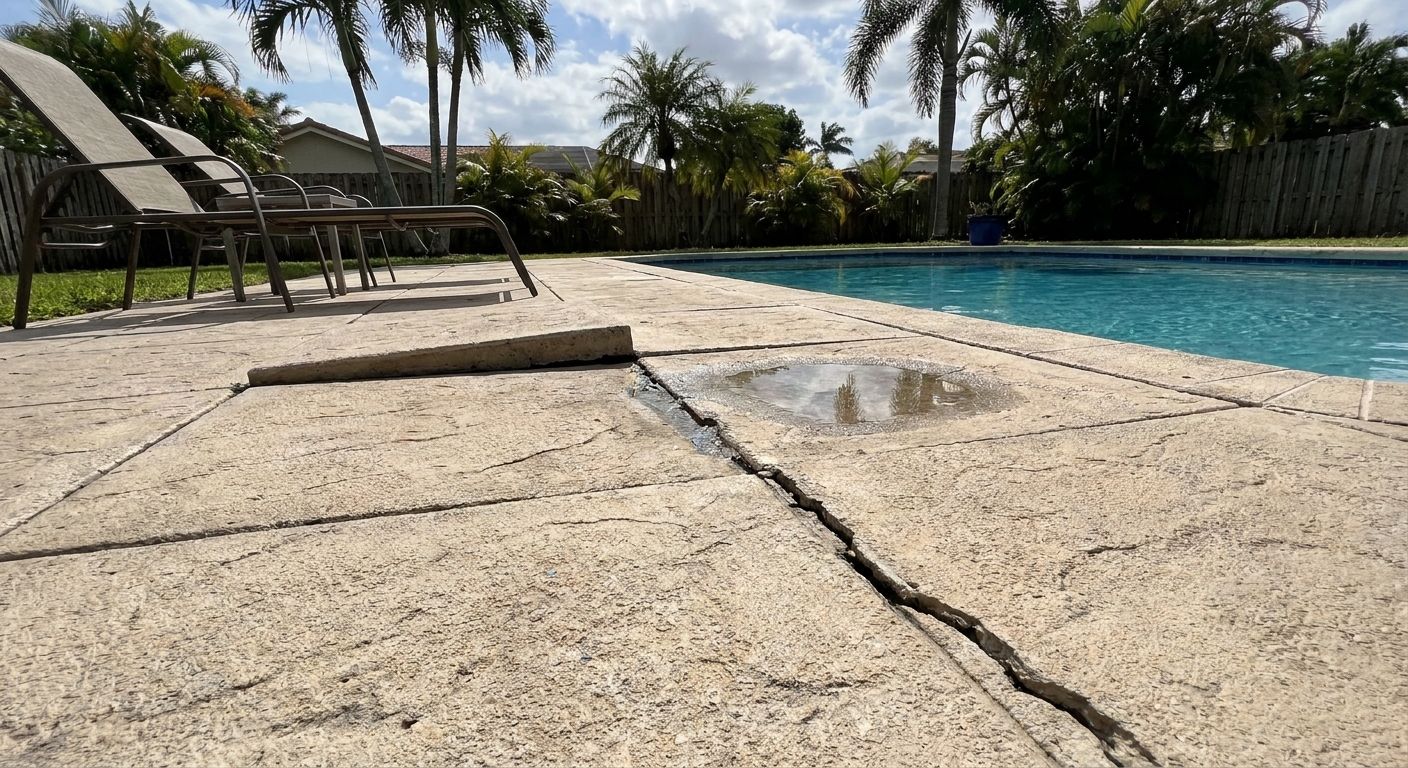
Hairline fractures are normal. Temperature swings cause concrete to expand and contract, and minor surface cracks are part of that process. But when those cracks start widening, branching out, or running parallel to the pool edge, we're seeing movement. The slab is no longer resting evenly on its base. Something underneath has given way, and the concrete is telling you about it.
Pay attention to where cracks appear and how they spread. A single crack might be cosmetic. Multiple cracks radiating from the same corner? That's settlement. Cracks that widen after rain? That's erosion. And cracks that run alongside your pool coping are signaling that the deck and pool structure are moving at different rates. None of these are problems you can patch with sealant and forget.
Water That Doesn't Drain Is Screaming at You
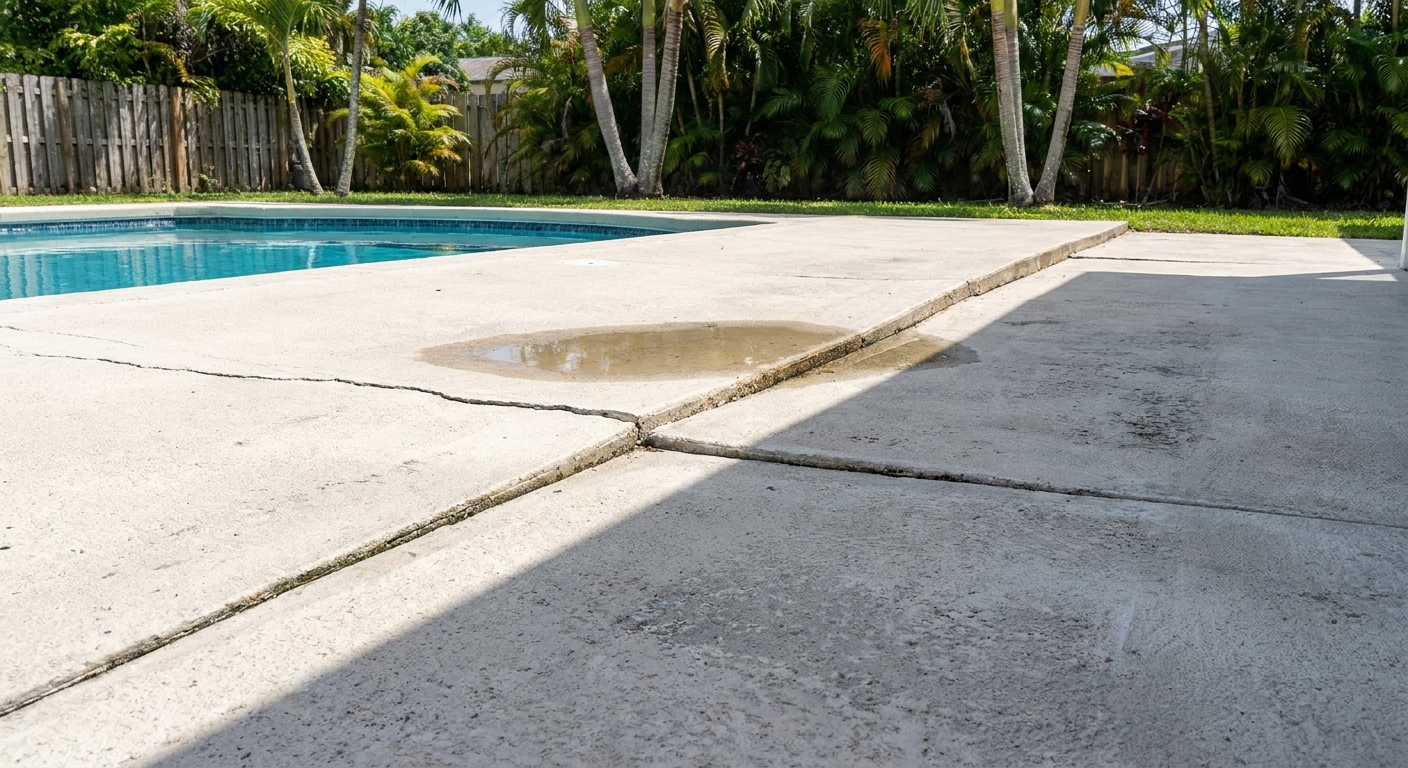
After a storm or a pool session, the deck should dry evenly. Water should flow toward drains or off the edges. When it puddles in random spots, that's a level problem. The surface has dipped, tilted, or sunk just enough to create low points. Pooling water accelerates the issue by seeping into cracks, washing out the base material, and freezing expansion joints in place.
We see this most often near the pool perimeter and around drains that were installed without accounting for settlement. The water sits there, day after day, slowly eating away at the sub-base. Algae grows. The surface gets slippery. And the longer it pools, the worse the underlying erosion becomes. Fixing drainage isn't optional. It's the difference between a stable deck and one that collapses section by section.
Tripping Hazards Mean Immediate Action
If your foot catches on a raised edge, that's not a quirk of the design. That's a slab that's lifted or a neighboring section that's dropped. Either way, someone's going to get hurt. We've seen twisted ankles, scraped knees, and worse — all from lips that measured less than half an inch. The liability alone should get your attention, but the structural implications matter just as much.
Raised sections usually mean one of two things. Either the soil underneath has expanded due to moisture, or a nearby section has sunk and created a relative height difference. Both scenarios require professional assessment. Grinding down the lip might eliminate the tripping hazard, but it doesn't address why the movement happened in the first place. And if it happened once, it'll happen again unless the root cause gets fixed. Trip hazards in Palm Beach County walkways share many of the same underlying causes and warning signs as uneven pool deck areas.
Gaps and Separation Tell You What's Moving
The coping around your pool should sit flush against the deck. When gaps start opening up, the deck is pulling away from the pool structure. This happens when the soil supporting the deck settles unevenly compared to the pool shell, which typically rests on a more stable foundation or compacted fill.
These gaps aren't just ugly. They let water infiltrate the space between the pool and the deck, which accelerates erosion and can compromise the pool's structural integrity. We also see this with expansion joints that no longer align properly. They're designed to accommodate movement, but when they start separating or appearing uneven, the deck is shifting beyond normal tolerances.
- Coping gaps wider than a quarter inch
- Expansion joints that have shifted vertically
- Separation between the deck and any attached structures like steps or planters
- Visible soil or voids beneath the coping line
- Caulking or sealant that has pulled away or cracked
Loose Pavers Are the First Domino
For those with paver decks, instability shows up differently. Individual stones start rocking when you step on them. Edges lift. Sand between the joints washes out. These aren't isolated issues — they're symptoms of a base that's no longer level or properly compacted.
Pavers rely on a stable sand bed and solid compaction. When water infiltrates or the ground settles, that base erodes. The pavers themselves are fine, but they're sitting on a foundation that's compromised. Resetting a few loose stones might look like a fix, but unless the base is re-leveled and re-compacted, the problem will migrate to adjacent areas within months.
- Pavers that wobble or tilt when walked on
- Sand erosion creating gaps between stones
- Edge restraints that have shifted or pulled away
- Sunken sections where multiple pavers have dropped together
- Water pooling between pavers instead of draining through
Doors and Gates That Stick Are Structural Clues
We don't always think about how foundation movement affects everything anchored to it. Pool gates that used to swing freely now drag on the deck. Doors to pool houses or storage sheds suddenly stick. These aren't hardware failures — they're indicators that the frame or post is no longer plumb because the ground beneath it has shifted.
This is especially common with gate posts set in concrete footings. If the deck around the post settles while the post stays put, or vice versa, the gate will bind. It's a subtle sign, but it's reliable. And it usually means the settlement isn't limited to one small area — it's affecting the larger pool deck footprint.
- Gates that drag on the deck surface
- Latches that no longer align properly
- Posts that lean or appear tilted
- Hinges that bind or require force to operate
- Gaps between the gate and frame that weren't there before
What Happens If We Ignore the Signs
Procrastination doesn't make these problems go away. Uneven decks get worse, not better. Water continues to erode the base. Cracks widen and multiply. Tripping hazards become lawsuit magnets. And what might have been a straightforward leveling job turns into a full replacement with excavation, new base material, and structural reinforcement.
In Palm Beach County, the weather accelerates everything. A deck that's mildly uneven in January can be a safety hazard by June after a few tropical storms. Insurance companies don't look kindly on documented hazards that weren't addressed. Neither do personal injury attorneys. The cost of fixing it early is always a fraction of what you'll pay later — financially and otherwise. Understanding how weather affects concrete in Palm Beach County helps explain why these problems develop and worsen over time.
- Increased erosion from standing water
- Structural damage to the pool shell or coping
- Higher repair costs as the affected area expands
- Liability exposure from slip-and-fall incidents
- Decreased property value and curb appeal
Getting a Professional Assessment Matters
We bring in specialists who understand soil conditions, drainage, and concrete repair specific to this region. They'll assess not just the symptoms but the underlying causes. Is it poor compaction from the original install? Root intrusion? A broken drainage line? The fix depends entirely on the diagnosis, and guessing wrong costs more in the long run.
Solutions range from slab jacking to re-leveling to full replacement, depending on severity. Drainage improvements often accompany the repair to prevent recurrence. And documentation matters — both for your records and for any future buyers who'll want to know the deck was professionally addressed. When deciding between resurfacing or replacing your pool deck, understanding the extent of settlement and damage is crucial to making the right choice.
- Soil testing to identify composition and moisture levels
- Drainage evaluation to locate problem areas
- Level surveys to measure exact settlement amounts
- Structural inspection of the pool and surrounding areas
- Repair recommendations with cost and timeline estimates
Prevention Beats Repair Every Time
Regular inspections catch issues before they escalate. We walk the deck quarterly, looking for new cracks, checking drainage after storms, and monitoring any areas that showed minor settling previously. It's not glamorous, but it works. Most major deck failures had warning signs months or years in advance that went unnoticed or ignored.
Maintenance also includes managing water flow, trimming roots that threaten the slab, and sealing cracks before they become channels for erosion. These aren't expensive interventions. They're common sense practices that extend the life of your investment and keep your pool area safe and functional year-round. Addressing problems while they're small keeps them from becoming emergencies — and keeps your weekends free for swimming instead of dealing with contractors. For professional help with uneven surfaces, concrete grinding services can eliminate lips and level transitions without full replacement. If you're ready to address settlement issues or explore options for your pool area, pool deck services can provide targeted solutions. You can also view examples of completed projects in our photo gallery to see the quality of work and range of repairs possible.
Let’s Keep Your Pool Deck Safe and Level
We know how quickly small issues can turn into big headaches around your pool. Let’s work together to spot the warning signs early and keep your deck safe, beautiful, and ready for every gathering. If you’re seeing cracks, puddles, or uneven spots, don’t wait—call us at 561-436-5977 and let’s talk about your options. When you’re ready to take the next step, request a quote and we’ll help you protect your investment for years to come.
‹ Back
Recent Posts
-
How Much Does a New Concrete Driveway in Palm Beach County Cost?
September 15, 2026
-
Can Concrete Grinding Make Walkways in Palm Beach County Safer?
September 1, 2026
-
-
-
Why Does Concrete in Palm Beach County Become Uneven?
July 21, 2026